Fair and Civilized Human Value in the Babad Sumedang
DOI:
https://doi.org/10.24127/hj.v14i2.14544Keywords:
babad sumedangm, pancasila, R.A.A Martanagara,Abstract
Pancasila is the basis of the state that becomes a reference in the life of the Indonesian people in carrying out all activities both in the form of a policy and implementatively in society. Fair and civilized humanity is one of the precepts in Pancasila which has moral teachings in daily life. Moral teachings have values contained in ancient manuscripts, especially before the independence of the Republic of Indonesia. The ancient manuscript is used as a reference for the community to be able to implement its teachings in daily activities. Sumedang Larang is a kingdom in West Java that still exists today. Sumedang Larang has ancient manuscripts or can also be referred to as Babad. Babad Sumedang by R.A.A Martanagara as one of the ancient manuscripts owned by Sumedang Larang is a babad that contains stories about the leadership of the Sumedang regent at that time. Until now, the implementation of the value of humanity and justice implemented by the Sumedang regent at that time has not been revealed, so it is interesting to reveal how the character of the Sumedang leader at that time, especially regarding the value of fair and civilized human values applied at that time. The method used in this research is the historical method with philological methodology, semiotic approach and oral tradition as supporting sources. The result of this research is the existence of fair and civilized human values applied by the Regent (King) Sumedang at that time was related to his conflict with the Sultanate of Cirebon.
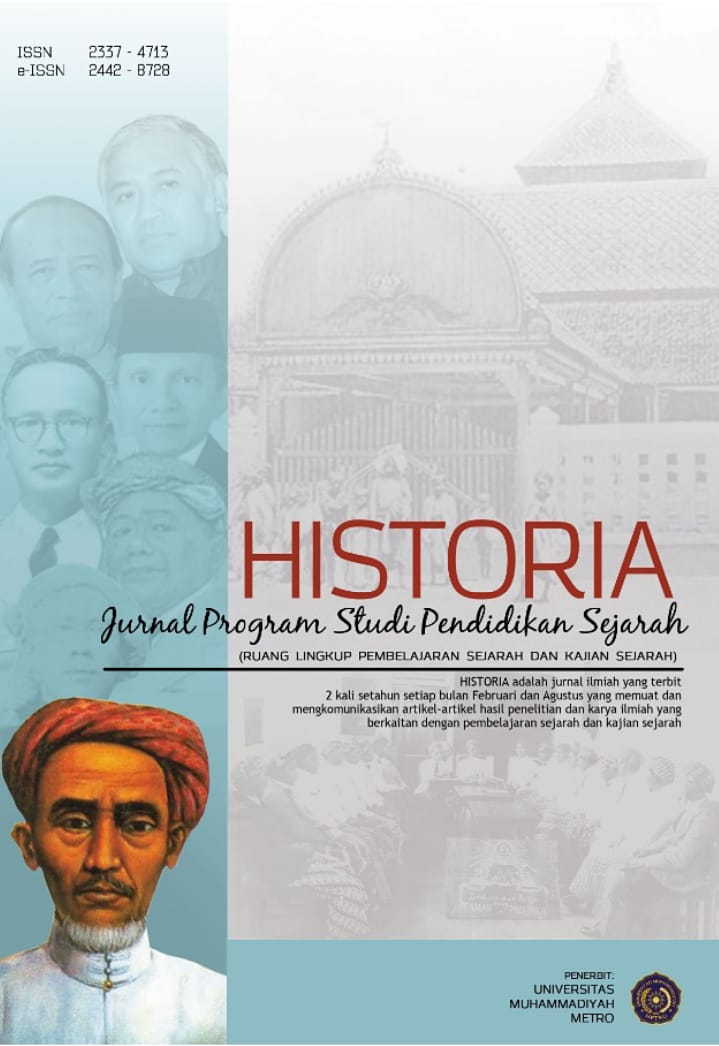
Downloads
Published
Issue
Section
License
This journal provides immediate open access to its content on the principle that making research freely available to the public supports a greater global exchange of knowledge. HISTORIA : Jurnal Program Studi Pendidikan Sejarah offers all authors of journal articles allows their research openly available, free access and time restrictions.
All articles published Open Access will be immediately and permanently free for everyone to read and download. Under the CC-BY license, authors retain ownership of the copyright for their article, but authors grant others permission to use the content of publications in HISTORIA : Jurnal Program Studi Pendidikan Sejarah in whole or in part provided that the original work is properly cited. Users (redistributors) of HISTORIA : Jurnal Program Studi Pendidikan Sejarah are required to cite the original source, including the author's names, HISTORIA : Jurnal Program Studi Pendidikan Sejarah as the initial source of publication, year of publication, volume number and DOI (if available).

HISTORIA by Pendidikan Sejarah UM Metro is licensed under a Creative Commons Attribution 4.0 International License.