The Role of Abdul Muis in the Youth Movement in Bandung 1913-1935
DOI:
https://doi.org/10.24127/hj.v14i2.13437Keywords:
abdul muis, sarekat islam, national movement,Abstract
The purpose of this study is to analyze the activities and contributions of Abdul Muis in strengthening the Sarekat Islam, to describe the political landscape of Bandung during that period, and to explore its impact on the development of the organization as well as the local community. This research employs the historical method with a qualitative approach. Data were collected through the stages of heuristics (source collection), criticism (source evaluation), interpretation (data analysis), and historiography (historical writing). The findings show that Abdul Muis played a central role in advancing Sarekat Islam in Bandung through his charismatic and strategic leadership. He succeeded in strengthening the organization by building networks, mobilizing the masses, and voicing resistance against Dutch colonial rule. Moreover, Abdul Muis’s contributions had a significant influence on raising nationalist awareness among the local community and shaping the political dynamics of Bandung during that period. This study is expected to enrich the understanding of the early history of Indonesia’s national movement and the role of key figures such as Abdul Muis in shaping socio-political dynamics.
Downloads
Published
Issue
Section
License
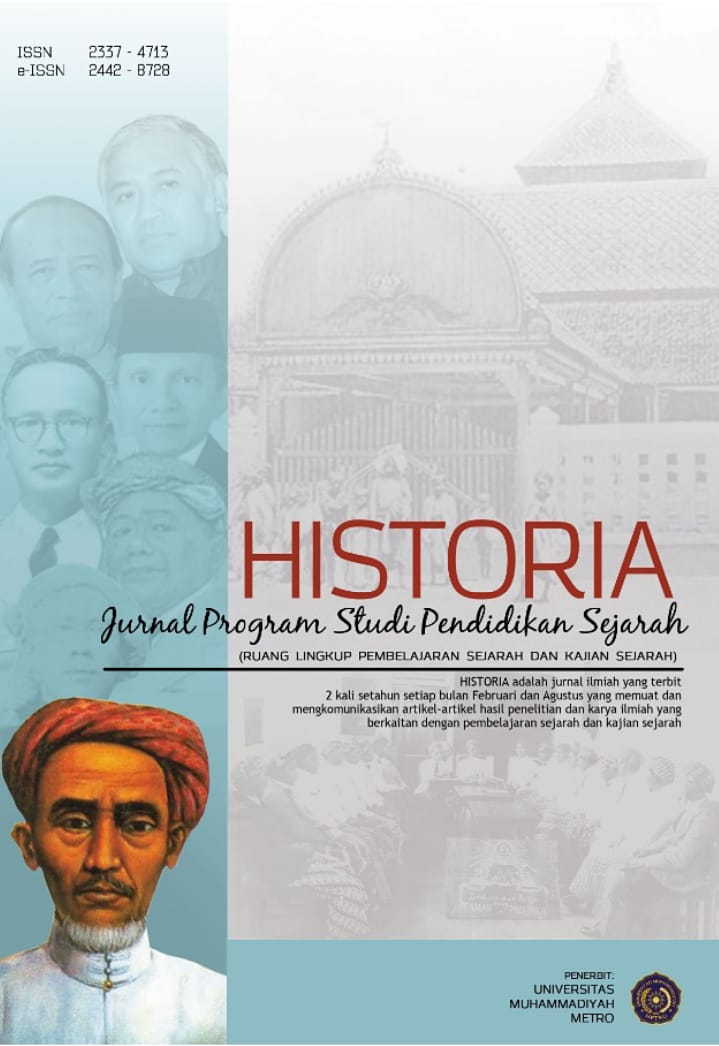
This journal provides immediate open access to its content on the principle that making research freely available to the public supports a greater global exchange of knowledge. HISTORIA : Jurnal Program Studi Pendidikan Sejarah offers all authors of journal articles allows their research openly available, free access and time restrictions.
All articles published Open Access will be immediately and permanently free for everyone to read and download. Under the CC-BY license, authors retain ownership of the copyright for their article, but authors grant others permission to use the content of publications in HISTORIA : Jurnal Program Studi Pendidikan Sejarah in whole or in part provided that the original work is properly cited. Users (redistributors) of HISTORIA : Jurnal Program Studi Pendidikan Sejarah are required to cite the original source, including the author's names, HISTORIA : Jurnal Program Studi Pendidikan Sejarah as the initial source of publication, year of publication, volume number and DOI (if available).

HISTORIA by Pendidikan Sejarah UM Metro is licensed under a Creative Commons Attribution 4.0 International License.